Exploring Eco-Friendly Packaging Trends Through Eco-Friendly Brands
As we entered the COVID era, the use of disposable products increased sharply. Environmental issues, long recognized as serious concerns, have recently become a major global topic. So what are eco-friendly brands doing to curb these problems and protect our precious environment? In fact, many...

As we entered the COVID era, the use of disposable products increased sharply.
Environmental issues, long recognized as serious concerns, have recently become a major global topic worldwide. So what efforts are eco-friendly brands making to curb these environmental problems and protect our precious planet?
In fact, many brands are emphasizing sustainability and rushing to launch “eco-friendly packaging,” joining the ranks of eco-friendly brands. So what exactly is eco-friendly packaging?
What Is Eco-Friendly Packaging?
 Photo by Spruce Refillable Cleaning on Unsplash
Eco-friendly packaging is also called environmentally friendly packaging or eco packaging. It refers to packaging developed to minimize harmful environmental impact from the very start, so that it has as little negative effect on the environment as possible.
For example, instead of overpackaging, it reduces packaging materials to the minimum; by using eco-friendly materials, it cuts down on waste of resources; and these days, biodegradable eco-friendly packaging made from natural materials such as sugarcane, which can be broken down by microorganisms and quickly returned to nature, is gaining attention. Eco-friendly packaging focuses on reduction, reuse, recycling, energy recovery, and waste treatment.
If you'd like to learn more about eco-friendly packaging, see: What Is Eco-Friendly Packaging?
Why Is Eco-Friendly Packaging Important for Eco-Friendly Brands?
 Photo by Jasmin Sessler on Unsplash
As mentioned earlier, with more people staying home due to COVID, disposable products — along with face masks, which have now become essential worldwide — are also causing significant environmental damage. With accelerating pollution leading to unpredictable climate change, protecting the environment for the planet we live on has become not a choice but a necessity!
Eco-Friendly Packaging from Eco-Friendly Brands
Many eco-conscious companies are already incorporating sustainability into their products through eco-friendly packaging.
They are reaching consumers with packaging made from biodegradable or eco-friendly materials, or with messages that help protect the environment, such as removing labels directly from products. So how many brands using eco-friendly packaging can we actually find in everyday life? Let’s take a look at some easy-to-find examples of eco-friendly packaging used by eco-friendly brands in our daily lives.
Eco Packaging for Eco-Friendly Brand SSG’s Packaging
 Source: Shinsegae
Shinsegae is the first eco-friendly brand in Korea to successfully develop a “microbial ice pack.”
It has replaced the “water ice packs” used for early-morning delivery with eco-friendly ice packs. Unlike ordinary water, microbial ice packs are infused with microorganisms, so they can be given to plants or even poured down the drain to help improve water quality — a truly eco-friendly packaging solution that does multiple jobs at once.
The packs left over after the water is drained are also easy to dispose of: the packaging made from recycled paper can simply be sorted as paper waste. Ice packs, once a necessity for delivering fresh products, have been reborn with eco-friendly materials — a true example of eco-friendly packaging.
Eco-Friendly Brand PUMA’s Eco-Friendly Shoe Packaging: Recycling and Minimal Use
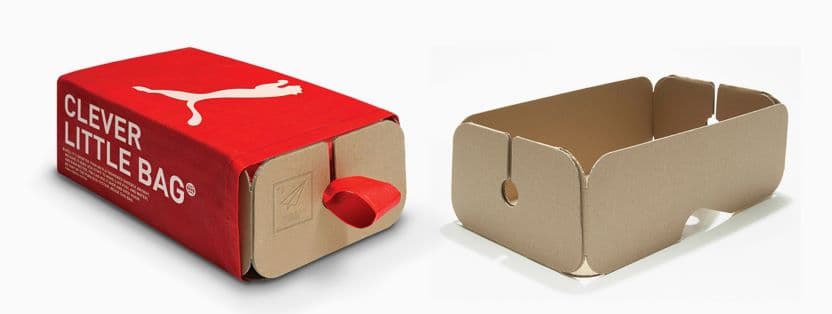 Source: fuseproject.com
This is a shoe package created by PUMA. At first glance, it looks like an ordinary shoe box, but it was transformed into eco-friendly paper packaging by creating the reusable Clever little bag. As a result, not only paper use but also the energy consumed in packaging production — electricity, water, fuel, and more — was dramatically reduced. PUMA reported annual savings of as much as 20 million megajoules of electricity, 1 million liters of water, 500,000 units of fuel, and 85 million sheets of paper. Seeing the numbers directly makes the savings truly impressive, doesn’t it?
If you want to create your own eco-conscious box, why not give it a try?
Eco-Friendly Brand Coca-Cola: Can a PET Bottle Become a PET Bottle Again?
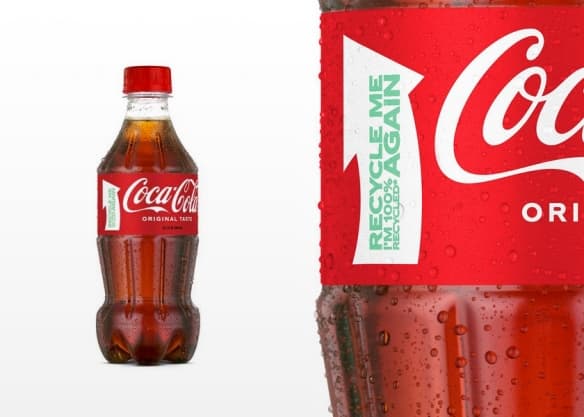 Source: coca-colajourney
Have you heard of 100% rPET bottles?
Coca-Cola, a company long associated with heavy plastic use, has been working hard to shake off that image and move closer to being an eco-friendly brand. In 2018, it declared a “World Without Waste” with a 2030 target and has been accelerating its search for alternative containers. It is exploring options such as paper bottles made from paper, and PET bottles made from ocean plastic waste. One of those alternatives is the rPET bottle, made by recycling 100% of PET bottles. As the name suggests, the process involves collecting used PET bottles, washing and shredding them, and then turning them into new PET bottles. Starting with a launch in the North American market this summer, Coca-Cola plans to gradually expand the lineup to products such as Sprite and smartwater.
Aesop’s Sustainability and Eco-Friendly Packaging
 Source: Aesop Twitter
As the importance of personal hygiene has been highlighted during COVID, hand sanitizers have surged in popularity, and Aesop’s hand sanitizers are also well loved for their quality and scent.
Did you know that Aesop, known for its lovely fragrances, is also an eco-friendly brand making major efforts to reduce its carbon footprint and minimize environmental impact? Aesop’s packaging always focuses on pragmatism, and all containers are designed with functional, minimalist aesthetics.
In addition, more than 70% of its plastic containers have been converted to rPET, a recycled plastic with a minimum 97% post-consumer recycled content, and for containers that use pumps, Aesop introduced a screw-cap version so the pump can be recycled, saving 12g of plastic per product in its efforts toward sustainability.
If you're looking for a method to create beauty product packaging, see: Beauty Packaging Design Guide
Amorepacific, the First in Korea’s Beauty Industry to Join Global RE100
 Source: Amorepacific website
Amorepacific, a well-loved eco-friendly brand in Korea and overseas, has consistently worked for the environment by applying metal-free pumps to products so used cosmetic containers can be recycled, and by collecting empty cosmetic bottles to increase the recycling rate of plastic containers through material recycling. Its holiday gift set, “Please Take Care of the Earth,” minimized plastic use with FSC-certified eco-friendly paper packaging made with sugarcane-derived material for biodegradability, and used a one-touch cap and colorless PET. Furthermore, it did not use adhesive labels, making it a truly eco-friendly package suited to the era of sustainability.
Thanks to these efforts, Amorepacific joined the global RE100 in March, becoming the first in Korea’s beauty industry to do so. As of March 2021, the group has around 290 companies worldwide participating, including Microsoft, Apple, and Google, and Amorepacific is the first and only company in the Korean beauty industry to join. Considering its long record as an eco-friendly brand working for the environment, this seems like a natural outcome.
Eco-Friendly? No. Sustainability Is a Must
Today, eco-friendly is being used in the sense of something essential, not optional — in other words, “must-have sustainability.” At present, as much as 165 million tons of plastic waste is threatening the world’s oceans, and the World Economic Forum warns that if this situation continues without improvement, by 2050 the ocean may contain more plastic than fish.
Now that we are living in the era of sustainability, why not develop eco-conscious consumption habits together with eco-friendly brands and their eco-friendly packaging, so that we can use the planet carefully and pass it on to the next generation, as the saying goes, “we did not inherit the earth from our ancestors; we borrowed it from our children”?
If you need eco-friendly packaging production to help your brand become more eco-friendly, Packative