Packaging Production Review for Mood in Honey: 4 Sweet Honey Boxes Filled with a Soft, Charming Mood
Hello, this is Packative. 💜 When a product lineup includes everything from individual items to sets and pouch products, the packaging also needs to be prepared in several types at once. If boxes with different structures are produced separately, costs and lead time increase—and brand colors can shift slightly from one print run to the next. Wh...
Hello, this is Packative. 💜
When a product lineup includes everything from individual items to sets and pouch products, the packaging also needs to be prepared in several types at once. If boxes with different structures are produced separately, costs and lead time increase—and brand colors can shift slightly from one print run to the next.
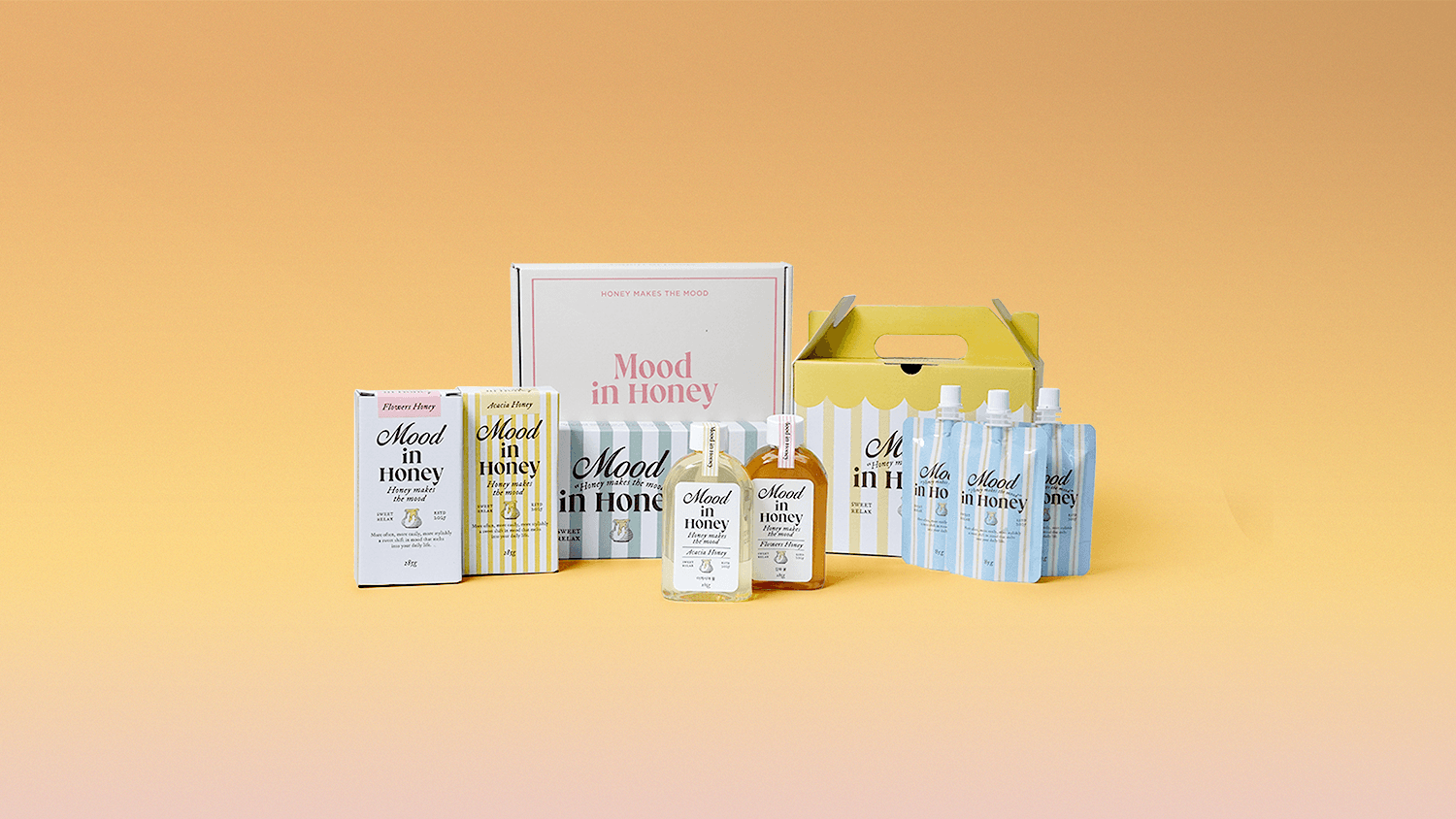
The Mood in Honey production case is especially worth referencing in situations like this, as it shows how four different box structures were produced at once while maintaining a balanced sense of brand consistency.
Mood in Honey Honey Gift Set: Production Details for 4 Corrugated Box Types
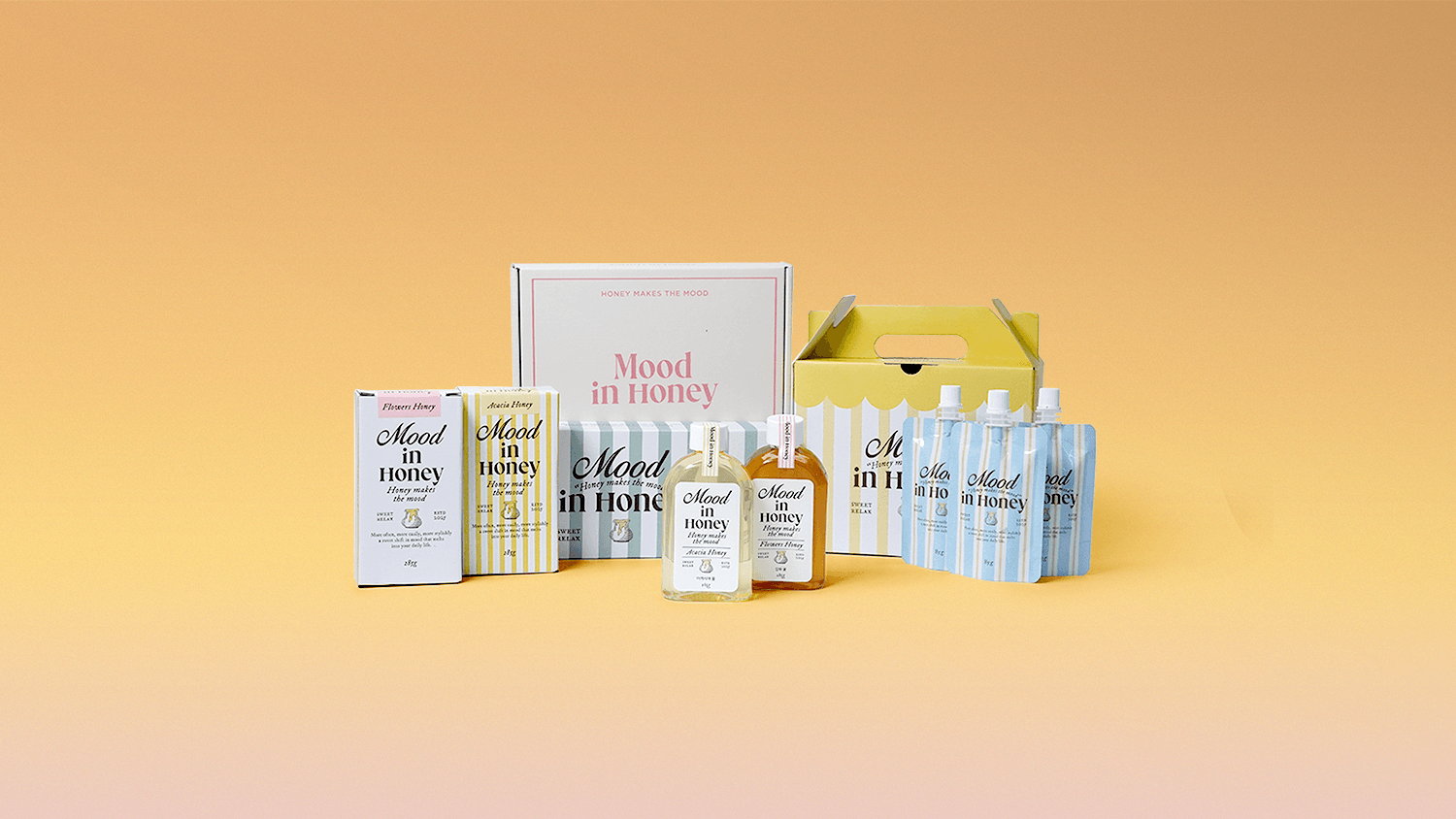 Packative x Mood in Honey Honey Gift Set corrugated box production review
| 📦 Type | Size (inner dimensions) | Material | Printing / Coating | Structure |
|---|---|---|---|---|
| Corrugated folding carton | 70 x 38 x 135mm | White K-K E-flute, SC 240 | Full Color (4-color process), Matte coating | 3-side glued |
| Corrugated G-style box (2-count) | 235 x 189 x 45mm | White K-K E-flute, SC 240 | Full Color (4-color process), Matte coating | Includes inner pad |
| Corrugated G-style box (3-count) | 283 x 105 x 50mm | White K-K E-flute, SC 240 | Full Color (4-color process), Matte coating | Includes inner pad |
| Corrugated handle box | 200 x 95 x 160mm | White K-K E-flute, SC 240 | Full Color (4-color process), Matte coating | 3-side glued |
Mood in Honey is a premium honey brand created from 45 years of beekeeping know-how. True to its slogan, "Honey makes the mood," the brand aims to make honey easier and more enjoyable to experience in everyday life.
This package was created to cover the entire product lineup at once—from individual honey bottles to 2-bottle sets, mini jam sets with three items, and honey pouch sets. To ensure a warm, premium mood from the moment the gift is received, all four types were designed with a strong focus on color consistency and finishing quality.
Why Matching Common Specifications Matters When Producing Multiple Boxes at Once
When producing multiple box types with different structures, standardizing the common specifications allows the boxes to be produced with solid quality in a shorter period of time. In the Mood in Honey case as well, production was made more efficient by unifying the material and printing specifications.
Although the folding carton, the two G-style boxes, and the handle box all differ in shape, the paper type, printing method, and post-processing style were kept the same. Grouping them under shared specifications makes it possible to run the printing process all at once, which streamlines the overall production flow.
By contrast, if each box is produced with different specifications, printing gets split into multiple runs, and the color tone can shift slightly during the process. As a result, even within the same brand, the packaging may end up with inconsistent tones from box to box. Using the same specifications is beneficial for both color consistency and shorter production lead time.
💡 When producing multiple box types at the same time, it is important to finalize the design drafts together as well. If all four types are handled at once, the workflow—design approval, dieline review, printing, lamination, cutting, and gluing—becomes interconnected, so if even one draft is delayed, the other three schedules can be pushed back as well.
📎 Curious which products are suitable for corrugated boxes? What kinds of products should be packaged in corrugated boxes?
Corrugated Folding Carton - The Basics for Single Glass Bottle Packaging
 Packative x Mood in Honey Honey Gift Set corrugated box production review
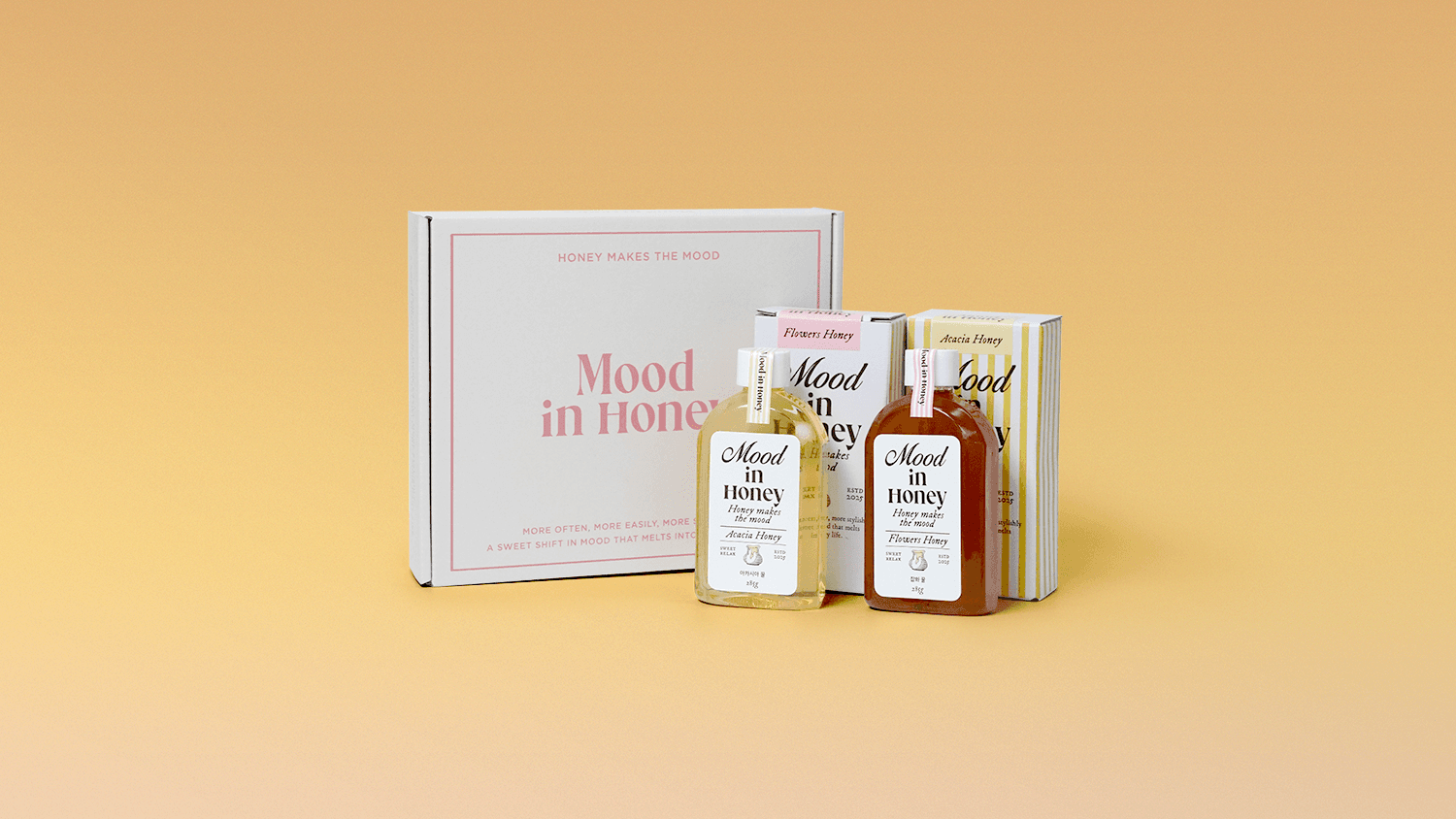
The individual packaging box for one honey bottle was produced as a 3-side glued corrugated folding carton. The most important factor in a folding carton is accurate inner dimensions. If a glass bottle moves around inside the box, the risk of breakage during shipping increases, while a box that is too tight makes it difficult to insert and remove the product.
For Mood in Honey, the inner clearance was set at about 1–2mm to match the bottle shape, allowing stable packaging without additional cushioning material. By using White K paper on the outer side, a clean printing background was secured, and the SC 240g laminated print clearly captured the stripe pattern and brand logo.
💡 When designing the inner dimensions of a glass bottle folding carton, the measurements should be based on the widest part of the bottle (cap, shoulder). Even if the body is narrow, the cap is often wide. It is generally recommended to leave 1–2mm of clearance in width and depth, and 2–3mm in height. If the clearance exceeds 3mm, the bottle may begin to move around. E-flute (about 1.5mm) provides a slight cushioning effect thanks to the flute itself, making it a suitable flute specification for glass bottle packaging.
Corrugated G-Style Box (2-count) - Recommended for Gift Sets
 Packative x Mood in Honey Honey Gift Set corrugated box production review
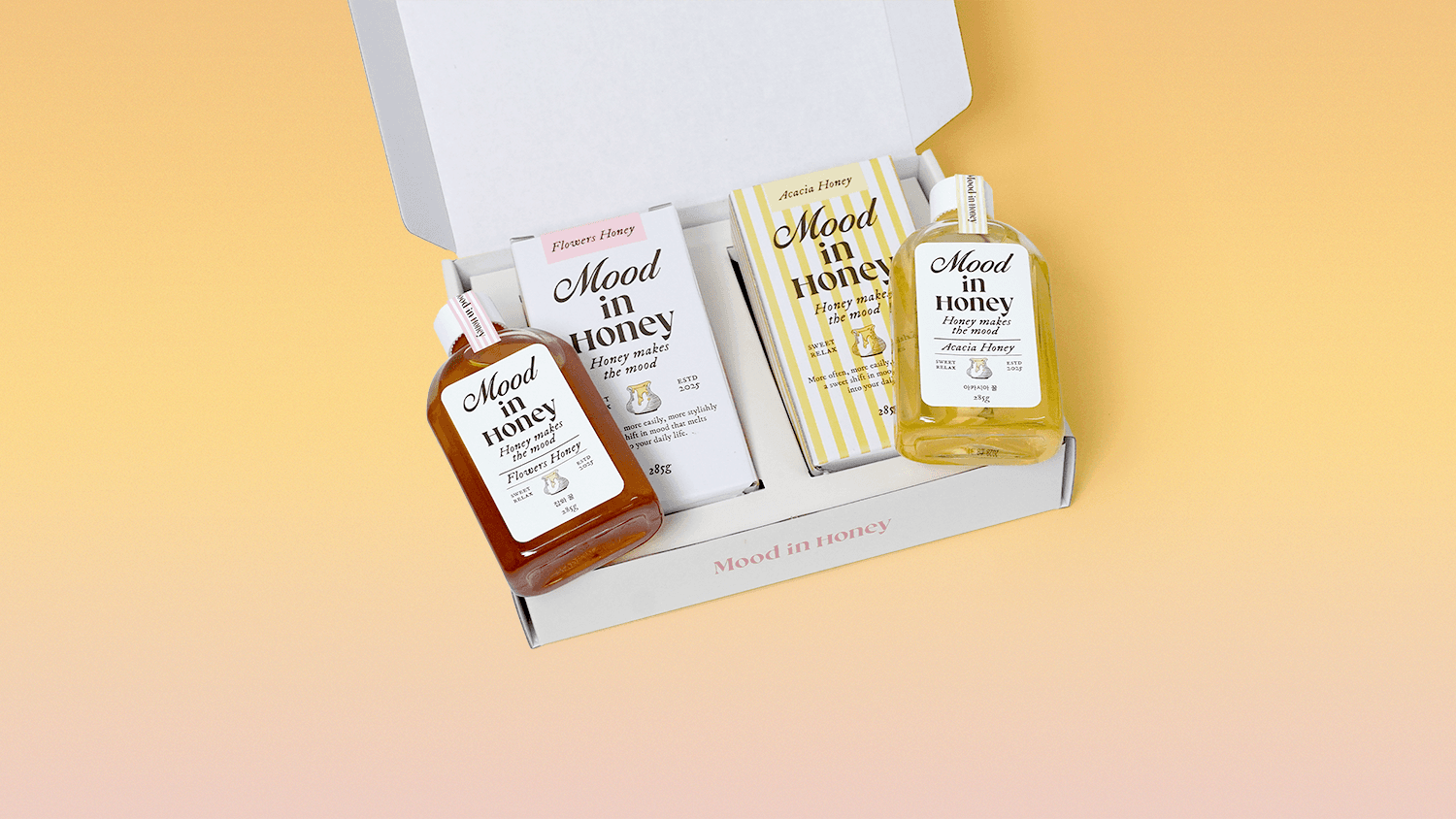
This G-style packaging box is designed for gift sets containing two honey bottles in folding cartons. Mood in Honey used leg pads to secure the two folding cartons and bottles in the exact positions. Because the leg pads are made from the same corrugated material as the main body (White K-K E-flute), they do not add much material cost while solving both cushioning and fixation at the same time. Placing the "Mood in Honey" logo on the inside of the lid also helps the brand identity stand out naturally the moment the box is opened.
💡 The most important factor when designing leg pads for a G-style box is height balance. If the top of the product sticks up more than 5mm above the pad, it will be pressed down when the lid closes; conversely, if the product sits below the pad, empty space will form and the contents may move. The basic rule is to set the pad height to roughly (box inner height – product height), while leaving 1–2mm of clearance when the lid closes.
Corrugated G-Style Box (3-count) - For Small-Quantity Product Sets
 Packative x Mood in Honey Honey Gift Set corrugated box production review
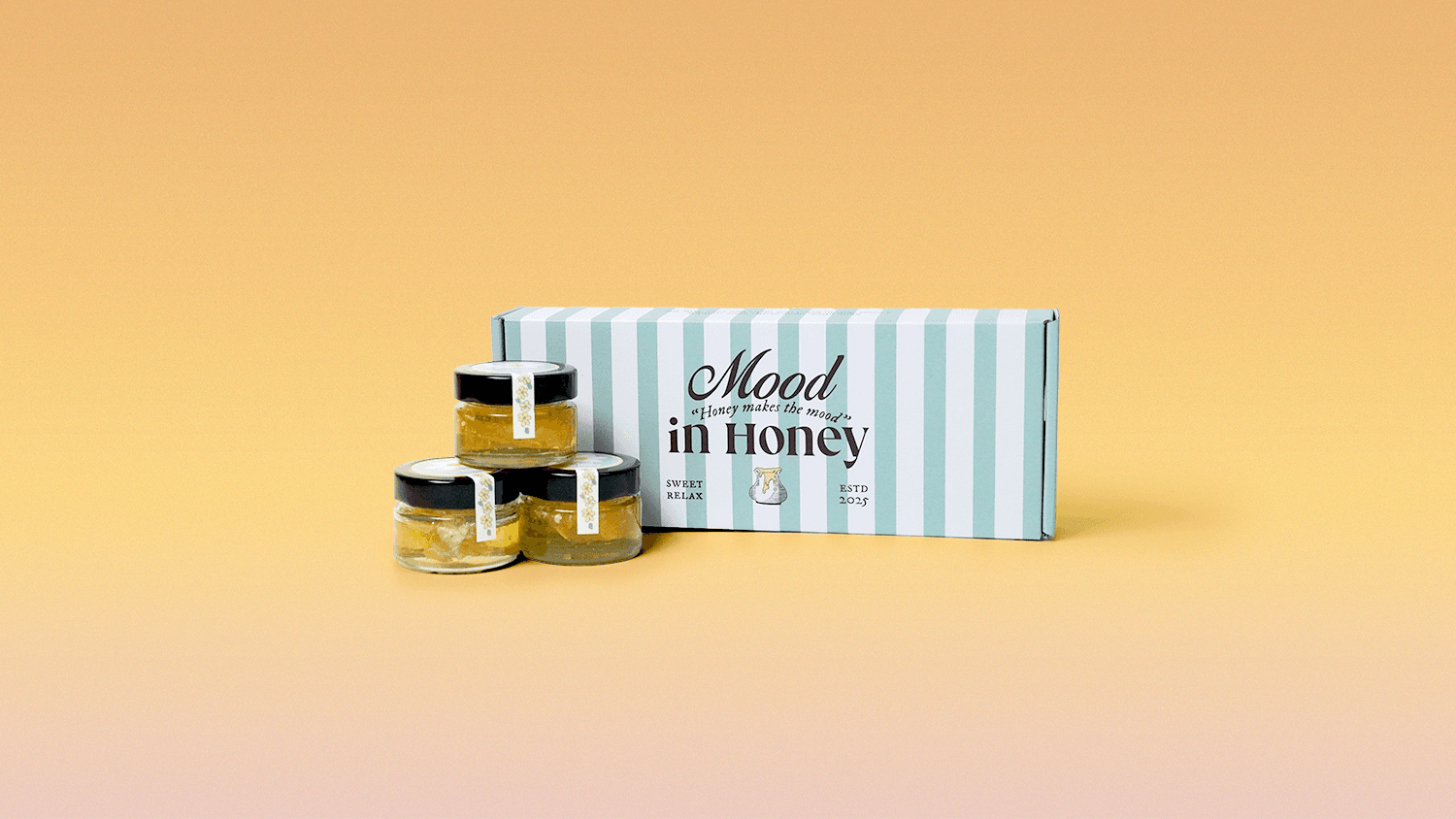
This G-style box holds three small honey jars arranged side by side. The material and printing specifications are the same as the 2-count G-style box, but the difference is that it was made in a longer horizontal proportion. The inner leg pad acts as a divider between the jars, preventing them from bumping into each other and creating a neat, organized look when the lid is opened.
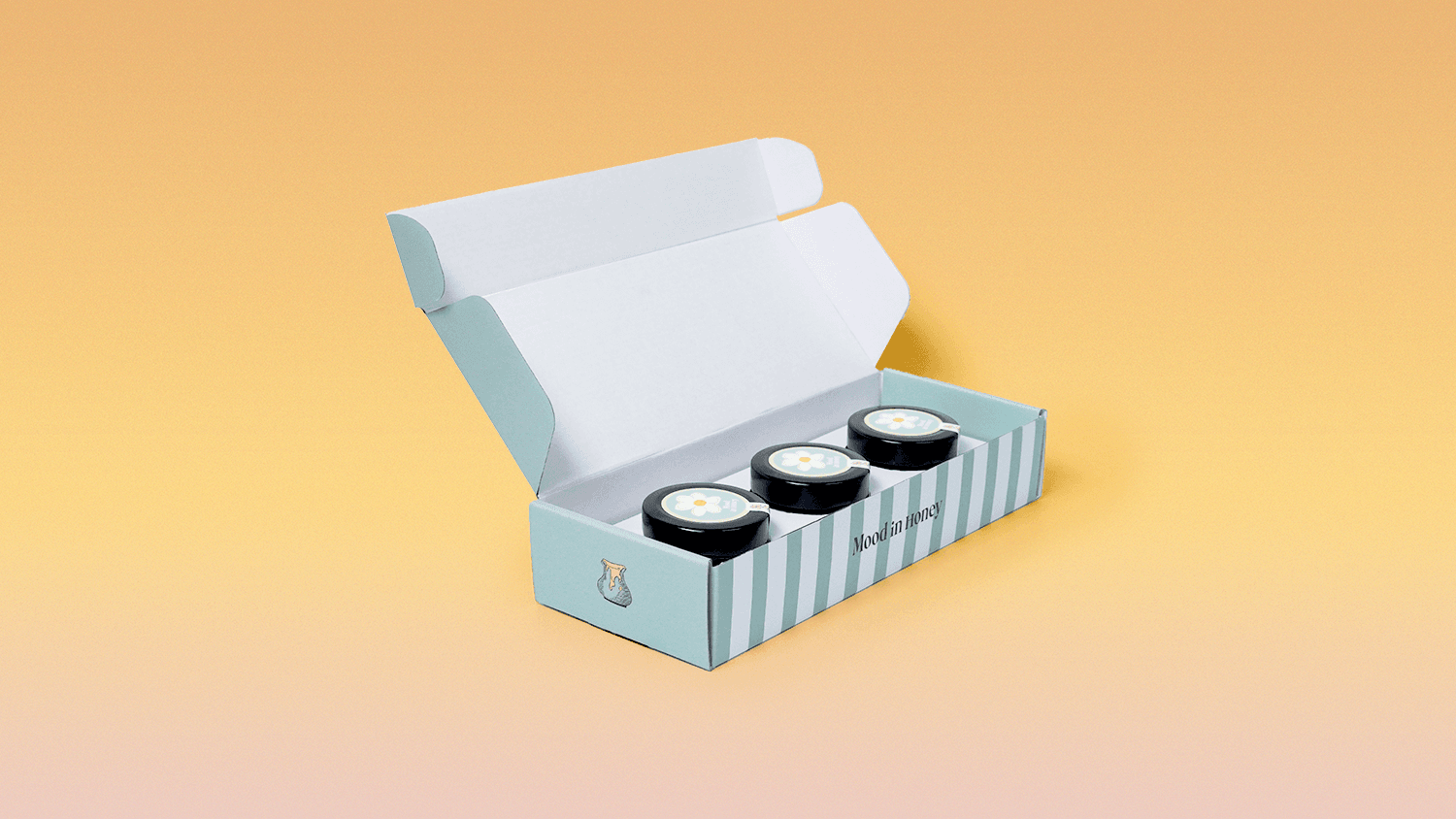 Inside the 3-count G-style box - the leg pad divides and secures the bottles
Because the G-style box does not require a gluing process, assembly is simple, and production cost is generally lower than adhesive-style boxes. It is an efficient structure for sets of mini bottles or small-quantity products.
💡 When placing multiple bottles in a row in a long G-style box, the divider spacing should be even, and at least 2–3mm of clearance is also needed between the bottles at both ends and the box walls. If manufacturing tolerances for corrugated board (±1–2mm) are not taken into account, the last bottle may not fit properly.
Corrugated Handle Box - For Pouch Sets
 Packative x Mood in Honey Honey Gift Set corrugated box production review
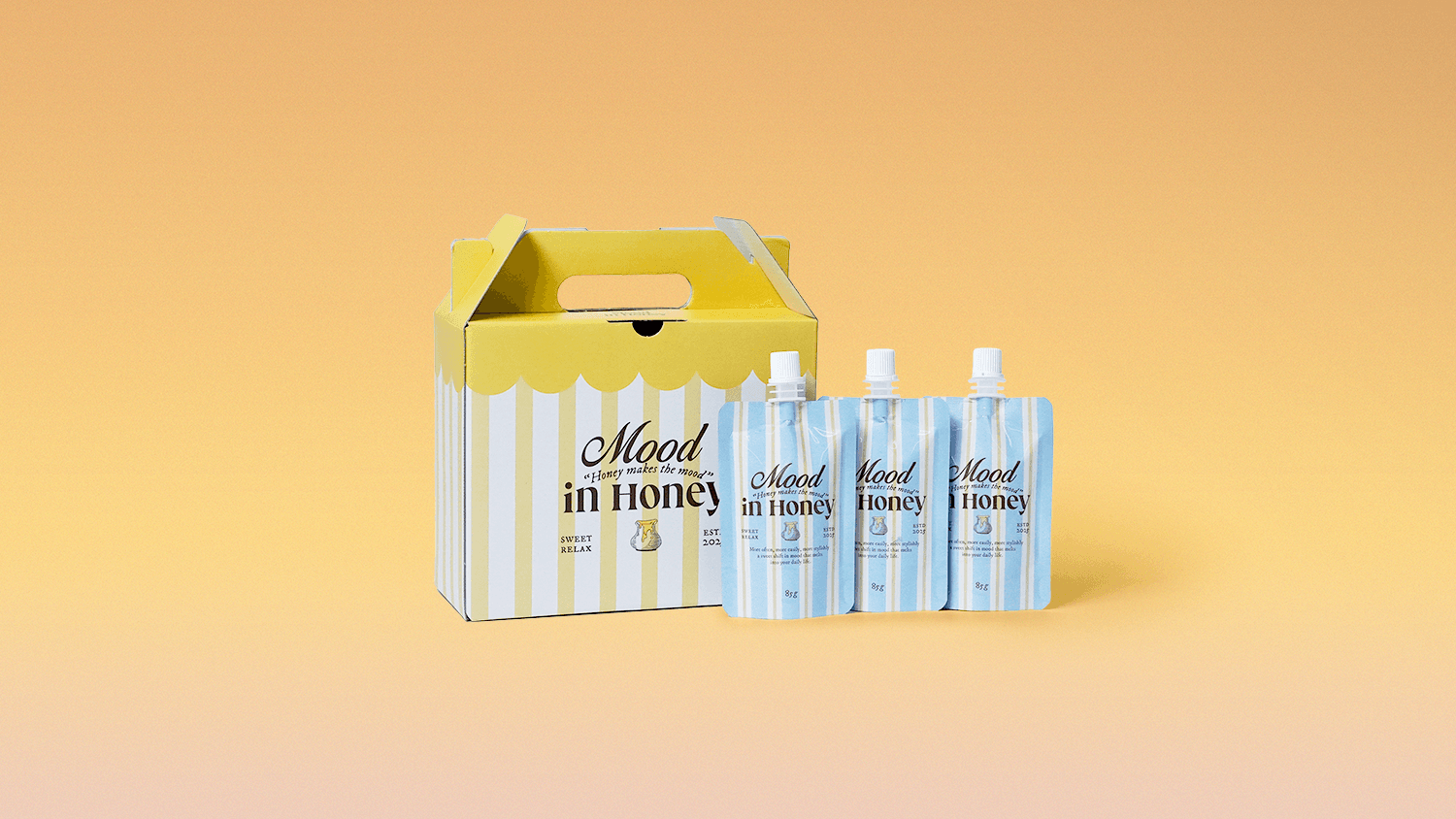
This is a handle box for pouch-style honey products. It has a 3-side glued structure with an integrated handle on top.
Handle boxes are often used for holiday gift sets and health food packaging. The corrugated material supports the weight reliably, while the handle makes carrying and handing over the package easy.
Mood in Honey sized this box so that three pouch honey products could stand upright inside, and applied a yellow and sky-blue stripe pattern to the front. The pastel color palette, combined with the handle structure, creates the feeling of handing over a gift bag.
Because it is a 3-side glued structure, it requires a gluing process unlike a G-style box. The glued areas must align precisely for a clean finish, so it is a good idea to carefully check the position and size of the glue tabs during dieline review.
💡 When standing pouches upright inside a handle box, it is best to design the size so that the product height stays within 80–90% of the box inner height. If the pouch is taller than the box, it may protrude through the handle opening. Also, when multiple items are packed tightly, they expand slightly, so leaving about 10–15% clearance in depth is more stable.
What Is Laminated Printing? A Way to Add Full Color to Corrugated Board
All four Mood in Honey boxes were produced using laminated printing. Laminated printing does not mean printing directly on corrugated board. Instead, the design is first printed on a separate paper sheet (SC 240g), which is then laminated onto the corrugated substrate. This method is ideal for achieving bright, vivid colors on corrugated packaging, like Mood in Honey’s pastel stripe pattern.
The process can be summarized as follows:
Step 1: Print the paper sheet — CMYK 4-color printing is carried out on SC 240g coated paper. Pastel tones, gradients, and photos can all be expressed freely.
Step 2: Post-processing — Matte coating is applied to the printed sheet. This reduces surface reflection, creates a calm texture, and protects the printed side.
Step 3: Lamination — The coated printed sheet is laminated onto the corrugated substrate (White K-K E-flute). The grain direction of the printed sheet and the corrugated board (flute direction) must match for a clean finish during the folding process.
Step 4: Thompson cutting and gluing — The laminated sheet is die-cut with a mold and finished by gluing the required sections.
💡 Because laminated printing requires the paper sheet and the corrugated board to be prepared separately, production takes longer than with standard paper boxes (about 2 weeks), so it generally requires around 3 weeks after design approval. When producing four types at once, all drafts must be finalized together to avoid delays. In addition, handling all four items at once with the same printing specification reduces the number of print runs and helps unify ink density, which is advantageous for maintaining brand color consistency.
📎 Want to learn more about printing colors? From Pantone to spot colors — color basics to know before printing
Print Supervision: Be Sure to Check Pastel Tones
The key design element of the Mood in Honey package is the pastel stripe pattern. The lighter and softer the color, the more visible even slight density differences become, so it is important to fine-tune the color accurately in the actual print result. Mood in Honey also worked with Packative to supervise the printing on-site and make detailed color adjustments.
Supervision is the process of checking the colors printed at the press and adjusting them to match the desired tone. For first-time projects, the typical workflow in practice is as follows.
Prepare a proof sheet. A proof printed at actual size serves as the color reference on site. Monitor colors differ from CMYK printed output, so a proof sheet is essential.
Share any spot color (Pantone) numbers in advance. If the brand’s signature color is specified as a Pantone number, share it with the printing team ahead of time. This makes the ink-mixing 기준 much clearer and communication more accurate.
Check the halftone dots with a loupe. Light colors with low ink density, such as pastels, have wider halftone spacing, so very small density adjustments can significantly affect the final result.
Visit at the printing start time. When the press first starts, it takes time for the ink density to stabilize, so it is best to check the job from the beginning on site.
💡 Even if it is your first time supervising a print run, there is no need to worry. The supervision staff will guide you on site and explain the color adjustment process.
If It’s a Food Gift Package, These Are the Things You Must Check Before Production
Unlike cosmetics or general merchandise, gift boxes for food require one extra layer of careful review before production. The suitable material and structure can change depending on whether the food touches the package directly and whether storage conditions must be taken into account.
Does the food touch the box directly?
- If the food touches the packaging directly, a food-contact-safe material must be used.
- If the product is individually packaged, you only need to confirm whether there is direct contact.
In the case of Mood in Honey, the honey is placed in the box after being first packaged in bottles or pouches, so the corrugated box serves as secondary packaging (outer packaging). Since there is no direct contact, the applicable standards may differ. On the other hand, for packaging such as bakery or fruit gift sets where the food is placed directly inside, it is important to confirm during the production stage whether the material is food-contact-safe.
Is the material and finish suitable for the storage environment?
- Refrigerated or frozen foods can cause corrugated board to weaken due to condensation.
- If needed, moisture-resistant coating or other materials should also be considered.
Products like honey that can be stored at room temperature are relatively stable, but refrigerated or frozen foods can easily make corrugated board damp because of condensation. In such cases, it is better to add a moisture-resistant coating or consider materials other than corrugated board as well.
Practical benefits of matte coating
Matte coating is not only elegant in texture, but it also has the advantage that fingerprints or oil marks on the printed surface are less noticeable than with glossy coating. Food packaging is handled frequently during distribution and display, so matte coating is a practical choice as well.
In short, food gift packaging requires one level more careful review than standard packaging. The material standard changes depending on whether the food touches the package directly, and the necessary finishing method changes depending on the storage environment. The earlier you check these points when starting a project, the less trial and error you will face—and the more reliably you can complete a package suited to the product.
📎 If you are preparing food packaging for the first time: Everything about food packaging design: how to catch attention and build loyalty
📎 Full checklist before box production: Everything you need for box production
Customer Review - Mood in Honey
"As someone launching a brand for the first time, I was worried about packaging production, but using Packative made it easy to check quotes and options in advance through the website, and it was great that I could review the dieline before production. Also, when I went in person to supervise because of a color issue, they kindly guided and responded to everything, which gave me confidence." — Mood in Honey
Brands Like This Are Good Candidates for Simultaneous Production of 4 Corrugated Box Types
If you sell food products in bottles or pouches in a variety of combinations—such as honey, jam, sauces, or tea—you may want to consider producing several types of corrugated boxes at the same time, just like in the Mood in Honey case.
By unifying the material and printing specifications, you can maintain brand consistency while also improving printing efficiency and color consistency. If you use laminated printing to express a full-color design and secure the glass bottles with leg pads or dividers, you can solve product protection and gift presentation in one package.
Complete a packaging lineup that fits your brand perfectly with Packative, where small-batch custom production is possible. 💜
🔽 Custom box production quotation inquiry 🔽
No more waiting after sending an inquiry. Packative products offer real-time quotes.
🔽 More portfolios here 🔽
Take a look at the valuable production experiences featured in other customers’ portfolios.
Frequently Asked Questions (FAQ)
📎 If packaging terminology feels unfamiliar: 11 terms you should know before making packaging